There are seasons when life feels like it is coming apart in your hands. The health worry, the family strain, the money pressure, the relationship that will not mend — all at once, all demanding an answer you do not have. And the harder you grip, the more seems to slip through your fingers.
If that is where you are, you are not alone, and you are not failing. You are standing exactly where one of the most quoted verses in the Bible was written for.
“Be Still, and Know That I Am God”
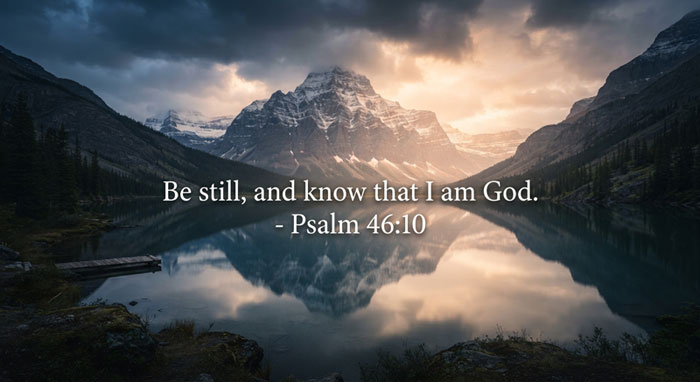
Psalm 46:10 says, “Be still, and know that I am God.” It is a beautiful verse, and it is often handed out like a calming slogan. But it was not written on a calm day. Psalm 46 opens in the middle of upheaval: “God is our refuge and strength, a very present help in trouble. Therefore will not we fear, though the earth be removed, and though the mountains be carried into the midst of the sea.” The psalmist is describing the ground itself giving way — and into that chaos comes the command: be still.
The Hebrew word behind “be still” is raphah. It means to let go, to release, to sink down, to stop striving. It is not pretending everything is fine. It is not ignoring the problem. It is the deliberate act of unclenching your hands from an outcome you were never able to control in the first place.
Why Stillness Feels So Hard
If stillness is so good for us, why does it feel almost impossible? Because control feels like safety. Worry feels like responsibility. Staying busy feels like faithfulness. Anxiety makes a quiet bargain with us: if you just think about it enough, plan enough, brace enough, you can prevent the worst from happening.
But none of those things actually hold your life together. Worry has never healed a body, mended a relationship, or paid a bill. It only exhausts the person doing the worrying. Stillness exposes an uncomfortable truth: we were never in control of outcomes. We are only ever in control of our responses. Letting go of the rest is not defeat. It is honesty.
What Stillness Actually Looks Like
Stillness is not a single grand gesture. It is a series of small ones, repeated daily.
Pause before you react. One breath, one short prayer, before the reply, the decision, or the spiral. That pause is often the difference between reacting out of fear and responding out of faith.
Pray before you problem-solve. Most of us bring God our problems after we have exhausted our own solutions. Try reversing the order: bring Him the problem first, and let the solutions come second.
Surrender one thing at a time. “Give it all to God” can feel too big to do. So do not start there. Name the one outcome you are gripping hardest today — the test result, the conversation, the bill — and release that one thing. Tomorrow, there will be another. That is enough.
Build small stillnesses into your day. A few minutes without fixing, scrolling, or planning. A short walk. An open Bible. A quiet room. Stillness is a muscle; it grows with use.
And remember the Israelites at the Red Sea. Trapped, with an army behind them and water in front of them, they had no plan at all.
Moses told them, “The Lord shall fight for you, and ye shall hold your peace” (Exodus 14:14). Their stillness was not inactivity — it was making room for God to act.
The Promise Underneath the Stillness
Notice how the verse ends: “and know that I am God.” The stillness works because of who God is, not because of how well you perform it. You are not the one holding the world together. He is. His presence is the anchor — “a very present help in trouble” — not His absence explained away.
That matters, because stillness is not a technique that guarantees the outcome you want. It is trust in the God who is present in whatever outcome comes. Some storms calm. Some do not. The promise is not that you will never be afraid again; it is that you will never face the storm alone.
Stillness and the Body
There is also a quieter reason stillness helps, one that belongs to both faith and science. When we live gripped by fear, the body stays on alarm: racing heart, tight muscles, shallow breath, sleep that will not come.
Pain itself often grows louder under that alarm. Practices of stillness — prayer, slow breathing, quiet — help the nervous system settle. The body begins to catch up with what the spirit already knows: you are held. Faith and the body’s wiring are not pulling in opposite directions here. They are pointing the same way: toward rest.
Start With One Thing
If everything feels out of control tonight, you do not have to fix it all before you rest. You do not have to untangle the whole future. Just let go of one thing. One outcome, one worry, one clenched fist, opened.
Be still — not because the storm is over, but because God is in it with you. And He is not asking you to hold everything together. He is asking you to trust the One who already does.
Struggling with feeling in control?
If you are having problems with anxiety — you do not have to work it out on your own.
Please contact me. Together we can look at what is getting in the way, and start building the skills that help you become fully trusting of the Lord.
Article courtesy of ChristianShrink.com, Written by Troy Todd, MA, LMHC